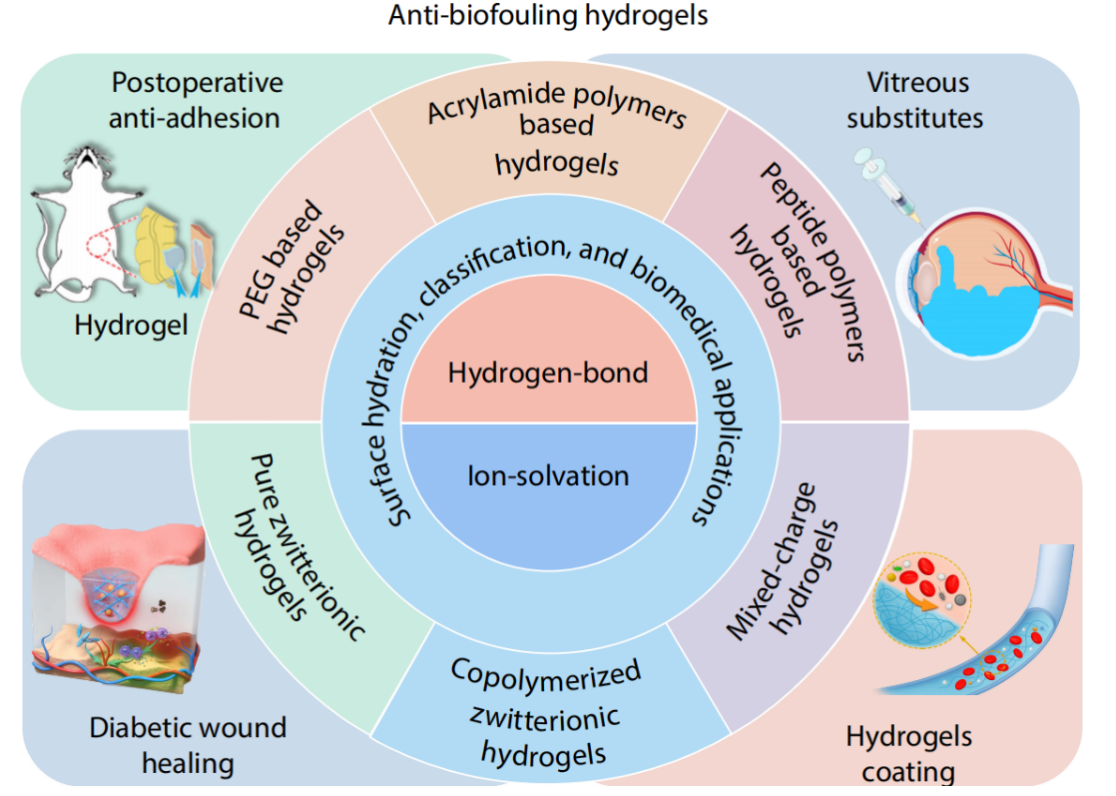
GA, UNITED STATES, July 6, 2026 /EINPresswire.com/ — Biofouling—the unwanted accumulation of proteins, cells, and bacteria on medical device surfaces—remains one of the biggest threats to implant longevity and patient safety. From blood-clotting catheters to fibrotic pacemakers, the cascade of adverse biological responses begins with a single event: protein adsorption. Now, a comprehensive review reveals how hydrogels, materials that are mostly water, can be rationally designed to prevent this initial step. By engineering surfaces that trap water molecules into a protective “hydration layer,” researchers are unlocking a powerful strategy to keep medical implants functioning safely for years, rather than months.
When a medical device is implanted, proteins instantly latch onto its surface—a process that triggers inflammation, immune rejection, blood clotting, and bacterial infections. Traditional anti-fouling coatings often degrade, lose effectiveness, or fail in the complex environment of the human body. Hydrogels, with their three-dimensional polymer networks and high water content, offer a natural advantage: they can hold water at their surface, creating a physical barrier that repels proteins before they can stick. Yet not all hydrogels are created equal—some hold water loosely, while others bind it with tenacious strength. Based on these challenges, the research team conducted an in-depth investigation into how different molecular designs influence hydration stability and anti-biofouling performance.
A team from Tianjin University, has published (DOI: 10.1007/s10118-026-3585-x) a review in the Chinese Journal of Polymer Science. The article, available online since April 7, 2026, and in print from June 5, 2026, systematically classifies anti-biofouling hydrogels based on their hydration mechanisms and evaluates their biomedical applications—including vitreous substitutes, anti-adhesion barriers, diabetic wound dressings, and device coatings.
The review identifies two distinct ways hydrogels build their protective water layers. The first, hydrogen-bonding hydration, relies on neutral hydrophilic groups—such as those in poly(ethylene glycol) (PEG) and acrylamide polymers—to trap water molecules through directional hydrogen bonds. The second, ion-solvation hydration, leverages zwitterionic materials that carry both positive and negative charges within each repeating unit. These charged pairs create extraordinarily strong ion-dipole interactions, binding up to eight water molecules per structural unit and forming a hydration layer far more stable than hydrogen bonding alone can achieve.
The zwitterionic approach has proven especially transformative. In animal models, zwitterionic hydrogels implanted beneath the skin resisted fibrotic encapsulation for more than three months, while conventional materials triggered dense scar tissue formation within weeks. As vitreous substitutes in rabbit eyes, these hydrogels maintained optical clarity and normal retinal function for over six months without triggering proliferative vitreoretinopathy—a common complication that leads to blindness with current silicone oil fillers. For diabetic wound healing, biodegradable zwitterionic patches actively remodeled the immune microenvironment, shifting macrophages from a pro-inflammatory to a healing phenotype while promoting angiogenesis. The review also highlights “mixed-charge” hydrogels, which achieve charge balance by combining separate cationic and anionic monomers, offering a simpler and more tunable alternative to classic zwitterionic designs.
“We’ve moved beyond the simple idea that hydrophilic surfaces are just ‘slippery,’” the authors said. “What really matters is how tightly water is held at the interface. Zwitterionic materials don’t just repel proteins—they make protein adsorption thermodynamically unfavorable by creating an energy barrier that’s simply too high to overcome. The real breakthrough is that we can now design hydrogels that maintain this hydration armor for months in the body, not just hours in a lab dish. That changes what’s possible for long-term implants.”
The implications extend across nearly every field of implantable medicine. For ophthalmology, hydration-stable hydrogels could replace problematic silicone oil in retinal detachment surgery, eliminating secondary complications like glaucoma and cataracts. In abdominal surgery, injectable anti-adhesion barriers could prevent the fibrous bands that cause chronic pain and bowel obstruction in over 90% of patients. For the growing epidemic of diabetic foot ulcers, smart zwitterionic dressings that monitor glucose and pH while actively promoting healing could reduce amputation rates. And as coatings for catheters, sensors, and cochlear implants, these materials promise to dramatically extend device lifetimes while reducing infection risk. The review provides a design roadmap that could accelerate clinical translation of next-generation, failure-resistant medical devices.
DOI
10.1007/s10118-026-3585-x
Original Source URL
https://doi.org/10.1007/s10118-026-3585-x
Funding Information
This study was financially supported by the National Natural Science Foundation of China (Nos. T2222013 and 52073203) and the National Key Research and Development Program of China (No. 2024YFB3814900).
Lucy Wang
BioDesign Research
email us here
Legal Disclaimer:
EIN Presswire provides this news content “as is” without warranty of any kind. We do not accept any responsibility or liability
for the accuracy, content, images, videos, licenses, completeness, legality, or reliability of the information contained in this
article. If you have any complaints or copyright issues related to this article, kindly contact the author above.

Media gallery