
It was a Tuesday morning when a 23-year-old apprentice at an independent shop in Ohio diagnosed a persistent CAN bus communication fault that had stumped two senior technicians for the better part of a week. He didn’t pull an all-nighter studying wiring diagrams. He didn’t call a hotline. He plugged in a THINKCAR T394 AI, spoke one sentence — “Hi Tyler, jump to the CAN bus topology view” — and had a personalized diagnostic plan and a probable root cause. He completed the repair before lunch.
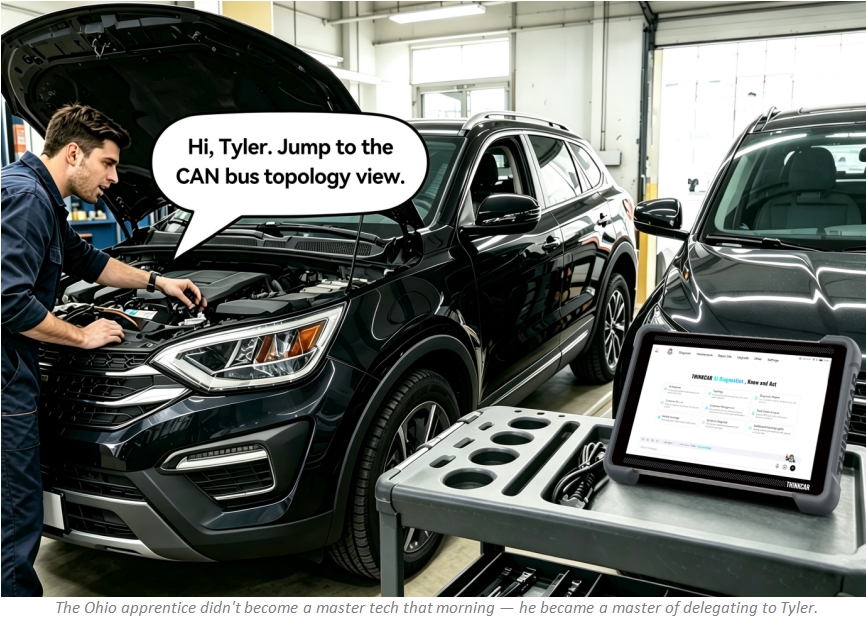
The shop owner asked him how he learned to do that. His answer was simple: “I didn’t. Tyler did.”
That apprentice isn’t an outlier. He’s a preview of what’s coming.
The Death of the “Walking Encyclopedia” Technician
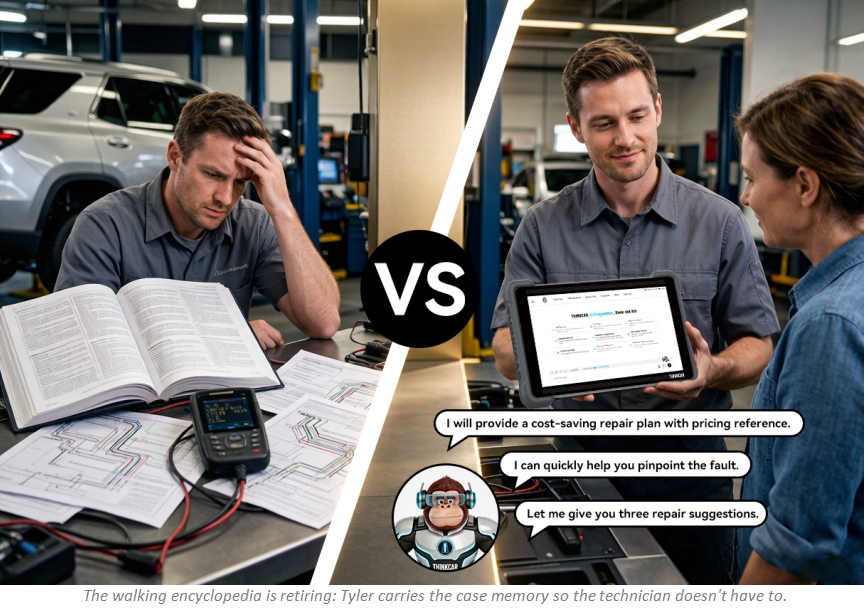
For thirty years, the metric of a great technician was straightforward: how much did you remember? The best techs were the ones who could recall a P0420 pattern on a 2014 Accord, who knew that certain VW 2.0 TFSI engines had timing chain tensioner issues at 60,000 miles, who had seen enough intermittent misfires to skip the obvious causes and go straight to the answer. Mastery was a function of accumulated case memory, and accumulating case memory took decades.
That model is breaking. A new participant in the bay can remember more cases in a single second than any human technician will encounter in a lifetime.
Tyler is THINKCAR’s AI Diagnostic Agent, built on ThinkLLM and running on the THINKCAR T394 AI. Its knowledge base spans hundreds of millions of diagnostic data records and fault cases, enough to surface pattern matches that would take a human career to encounter. Tyler auto-labeling system processes new diagnostic data at ten times the efficiency of manual annotation, with labeling accuracy exceeding 99.5 percent, ensuring the knowledge base grows without compromising quality.
The “Super-Individual” and the Multiplier Effect
What’s emerging in shops that have adopted AI-assisted diagnostics is a structural change in what a single technician can accomplish. Industry observers are calling it the rise of the “super-individual,” one technician paired with an AI agent that replicates the capabilities of an entire diagnostic team.
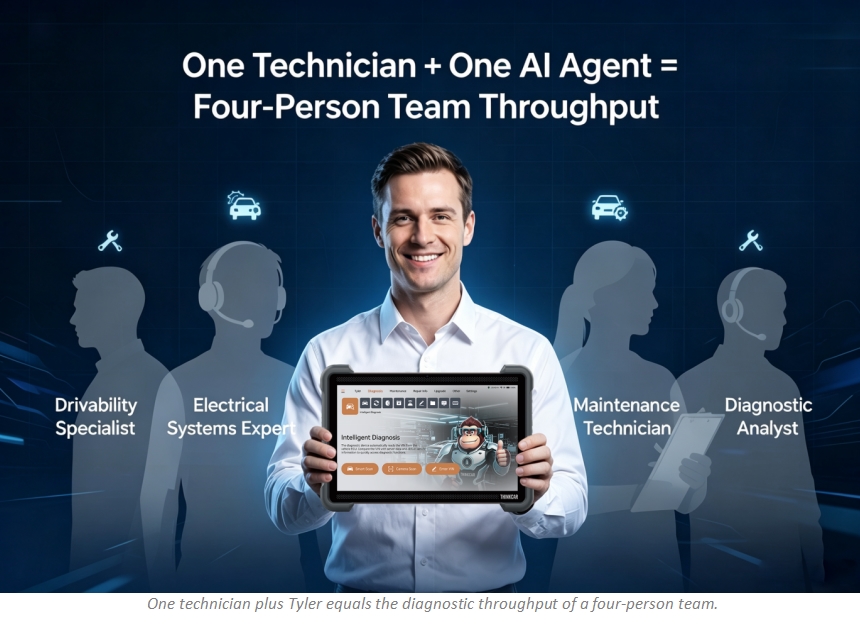
A diagnostic team at a large dealership historically meant a generalist for initial inspection and a drivability specialist for complex faults. Tyler compresses those roles into a single workflow through its multi-agent architecture: a system diagnostics agent and a maintenance function agent, all coordinated by ThinkClaw, all working the problem the moment the tool connects.
One technician. One AI agent. The diagnostic throughput of a four-person team.
For mobile mechanics working out of a van, this matters acutely. They can’t call a drivability specialist into the next bay. Tyler gives them a full diagnostic bench in a single device, and for technicians evaluating the best scan tool for mobile mechanics, that distinction between a code reader and an AI-assisted diagnostic partner is becoming the deciding factor.
What Moves to the Machine
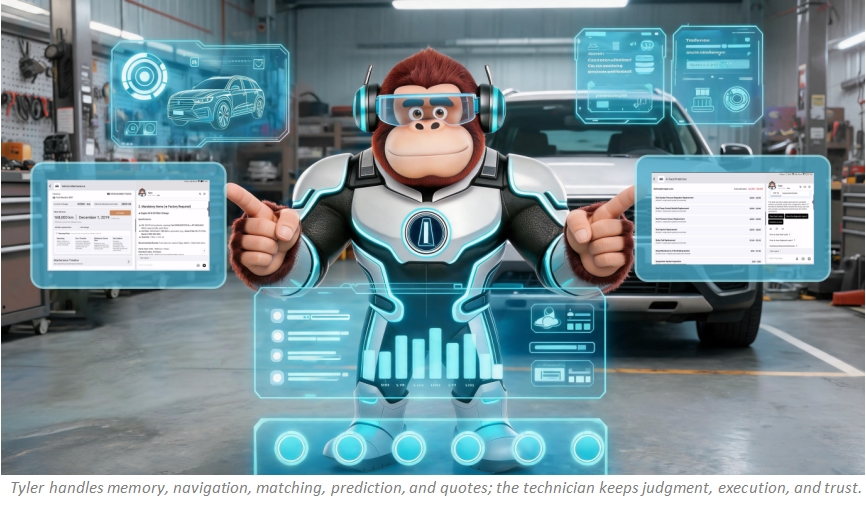
AI reallocates the technician’s cognitive load. Memory moves to Tyler. No one needs to memorize fault code definitions or model-specific quirks when hundreds of millions of diagnostic cases are already in the system. A single photo of a dashboard warning light cluster is enough for Tyler to identify the fault context. Navigation moves too: natural language replaces the twelve-menu-layer dig to reach a specific reset function. And pattern matching moves. Tyler identifies what’s broken, then predicts what’s about to fail based on vehicle history and aggregate data from similar vehicles, complete with estimated repair cost ranges that give customers transparency and shops trust.
What stays with the technician is arguably the harder part. Tyler proposes; the technician decides whether that diagnostic path fits this specific customer, vehicle, and budget. That’s the call that requires reading body language and understanding shop capacity. Execution stays human: torquing a bolt to spec and performing a brake bleed in the right sequence. And trust stays human. The customer looks for the technician behind the tablet, the one who can look them in the eye and explain, in plain language, what Tyler found and why the recommended repair matters.
The Old Path Was Already Broken
The traditional technician growth path is linear and slow: two to three years as an apprentice, then junior tech, then five to eight years to senior tech, then another five years to become a true diagnostic specialist. Each rung is earned by accumulating cases, one stubborn intermittent misfire at a time.
That path was already unsustainable. According to the TechForce Foundation, the technician shortage has reached a ratio of four open positions for every one qualified candidate. The industry cannot train enough master technicians within ten-year cycles to replace those now retiring. And the vehicles keep getting harder: the average vehicle on the road in the United States is now 12.8 years old, with aging systems stacking failures.
The industry has been treating the technician shortage as a supply problem. It’s also a leverage problem. But if a technician augmented by Tyler can handle the volume and complexity of what previously required a team, if one person plus an AI agent can run a bay with the throughput of a small diagnostic department, the equation changes. Shops do more with the people they have. Apprentices become productive faster. Senior technicians are freed from routine diagnostics to focus on the complex, ambiguous cases where human experience still matters most.
An apprentice with Tyler starts on day one with the case-matching capability of a technician who has hundreds of millions of diagnostic cases in memory. The growth curve shifts from accumulating cases to deepening judgment: learning to evaluate Tyler’s recommendations critically and execute repairs with precision.
THINKCAR isn’t suggesting that AI replaces the technician workforce. The definition of what a technician is has just expanded. The best technician in 2027 will be the one who delegates the best, who knows when to trust Tyler’s analysis and how to translate the whole process into trust at the service counter.
THINKCAR positions Tyler less as a conversational assistant than as an action partner — built to move the device from passively reading codes to actively anticipating failures.
“Tyler does not replace your technicians. It replaces the tools that waste their time,” said Peter, VP of THINKCAR’s Diagnosis Business Center.
The apprentice in Ohio didn’t become a master technician that Tuesday morning. He became something new: a supervisor of an AI that already was.
You wrench. Tyler handles the rest.
About THINKCAR
Founded in 2019, THINKCAR is a leading provider of AI-powered automotive diagnostic solutions. With AI patents and a nationally registered automotive AI algorithm, THINKCAR serves 2.4 million users across 215 countries and regions. Its product ecosystem spans 8 categories including diagnostic tools, TPMS, ADAS calibration, EV diagnostics, and remote service platforms. The T394 AI, its flagship Tyler-powered tablet, will be available through authorized dealers — visit thinkcar.com for details. Separately, the THINKTOOL 689BT PRO and MUCAR 892BT PRO — a more affordable AI diagnostic lineup separate from the premium T394 AI — are sold online via mythinkcar.com.
Sources & Methodology
Market size from 360iResearch (2026); repair-procedure data via Solera AutoData partnership; technician-shortage ratio from TechForce Foundation. Average vehicle age (12.8 years, 2025) from the U.S. Department of Transportation, Bureau of Transportation Statistics (BTS), Table 1-26: Average Age of Automobiles and Trucks in Operation in the United States; underlying analysis S&P Global Mobility. User, coverage, EPC, and performance figures (2.4 million users; 215 countries and regions; 48 million EPC records; 98%+ vehicle coverage; 99% of vehicle models; 99.5% auto-labeling accuracy; 10× annotation efficiency; ~5-minute workflow) are based on THINKCAR internal data and testing (2026). First-time fix-rate benchmark (75–85%) reflects industry estimates. ThinkLLM architecture describes THINKCAR’s proprietary design.
Media Contact
Company Name: THINKCAR TECH CO., LTD.
Contact Person: Jackie Lan
Email: Send Email
Country: China
Website: www.thinkcar.com


